
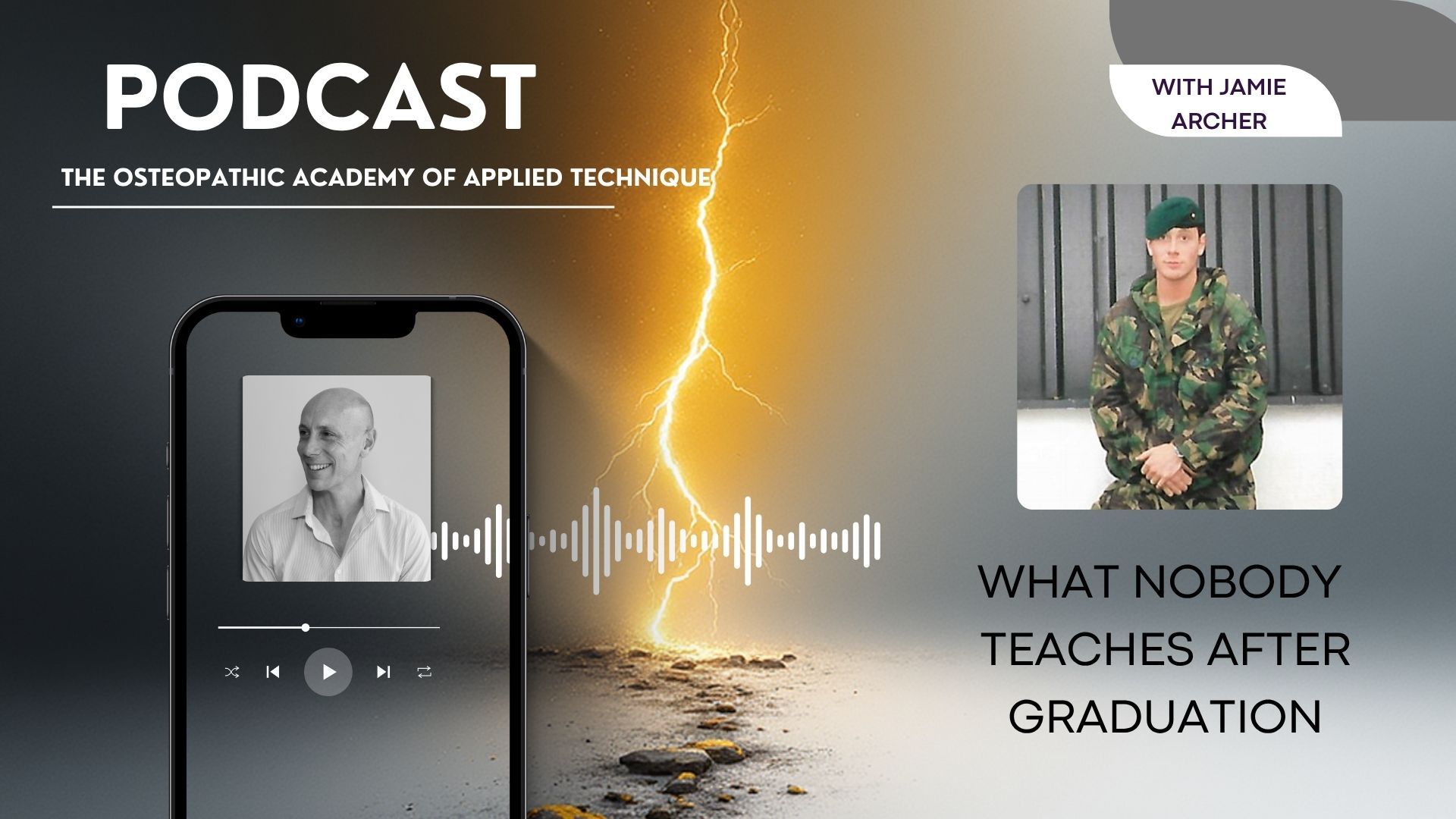
What Nobody Teaches After Graduation
Sep 20, 2026At 16 years old, Jamie joined the Royal Marines.
Like anyone going through recruit training, the focus was simple: get to the end, pass out, earn the green beret.
Recruit training felt like everything.
It was physically demanding, mentally exhausting and every day felt like a test.
When Jamie completed training he came out top of the tree. At that moment, it would have been easy to think he had made it.
But then he joined an operational Commando unit.
And very quickly he realised something important.
He had not reached the finish line.
He was only at the beginning.
Passing recruit training proved he was safe, disciplined and capable enough to join the unit. It did not mean he had mastered the role.
The real learning started after that.
And what stood out was how structured that development was.
He was surrounded by experienced Marines who had spent years refining their judgement, practical skill and instincts through deliberate practice and guidance. Training did not stop after qualification. It became more focused, more specific and more relevant to real-world demands.
Osteopathy is remarkably similar.
Undergraduate education gives you the foundations:
-
Anatomy
-
Physiology
-
Pathology
-
Principles
-
Assessment
-
Technique
And at the end of it, you qualify.
You earn the title osteopath.
But qualification does not mean you have mastered the profession.
It means you are safe enough to begin.
That is a very different thing.
One of the biggest misunderstandings in osteopathy is the belief that experience alone automatically creates expertise.
It does not.
You can spend years in clinic repeating the same level of thinking, the same assessments and the same techniques without truly deepening your understanding.
This is where many practitioners quietly plateau.
Some feel that something is missing and begin searching externally:
-
More techniques
-
More courses
-
More adjuncts
-
More modalities
They learn needling, cupping, scraping or increasingly complex rehabilitation systems.
None of those things are inherently wrong.
But they can become a distraction from the deeper work of osteopathic development.
Because what often needs refining is not another modality.
It is:
-
Anatomical understanding
-
Osteopathic thinking
-
Palpation
-
Technical precision
-
The application of principles
Many practitioners in their first one to five years feel this, even if they struggle to describe it.
They know more than they can consistently apply.
They can perform techniques but are not yet fully confident in what they are feeling.
Some treatments feel excellent. Others feel technically correct but lack depth, specificity or clarity.
That stage is normal.
But improvement does not happen automatically.
The osteopaths who continue to grow are the ones who deliberately refine their craft.
They:
-
Revisit anatomy until it becomes alive beneath their hands
-
Apply osteopathic principles in every patient interaction
-
Refine techniques until they become precise and therapeutic
-
Reflect on difficult cases
-
Learn from skilled practitioners
-
Continue developing long after graduation
Over time, something changes.
Treatment becomes:
-
More specific
-
Less forceful
-
More adaptable
-
More thoughtful
The osteopathic principles stop being theory and start becoming the framework that guides every clinical decision.
You stop trying to force change.
You start understanding how to support the body’s ability to adapt and self-regulate.
And this is where osteopathy becomes deeply rewarding.
Not because you know more random techniques.
But because your hands, your reasoning and your principles begin working together.
The years after graduation are some of the most important years in your development.
Not because they are easy.
But because this is the period where you decide whether you will simply gain experience… or truly deepen your understanding of osteopathy.
If you feel there is another level to your practice, you are probably right.
And reaching that level requires more than time.
It requires deliberate development.
And that is what we do in The League of Extraordinary Osteopaths - The LXO.
You can listen to Jamie talk about this topic on our podcast.
Stay connected with news and updates!
Join our mailing list to receive the latest news and updates from our team.
Don't worry, your information will not be shared.
We hate SPAM. We will never sell your information, for any reason.
